Tuesday, February 28, 2006
Tibet Foundation Homepage
Tibet Foundation Homepage: "Tibet Foundation is a registered charity (no. 292400), founded in 1985, which works towards creating greater awareness of all aspects of Tibetan culture and the needs of the Tibetan peopl"


Thursday, February 23, 2006
Sunday, February 19, 2006
Propaganda State
This is an interesting opinion piece from an interesting news source.
The Agonist | thoughtful, global, timely: "The Iraq war was sold on lies. How it occured was simple - someone in the administration, or one of their mouthpieces in the media would make a claim (remember the 'drones of death?'). The claim would be frontpage news and on the networks. In a few days it would be debunked (the drones of death turned out to be oversize model airplanes), but that wouldn't get mentioned in the media prominently - in the newspapers it would be buried on the back pages and it often wasn't mentioned on the cable networks at all."
Oracle Bones: Two
Oracle Bones: A Journey Between China's Past and Present by Peter Hessler.
Harper Collins has selected me to read a book on China by Peter Hessler.
I filled out an Application with the publisher and wrote a short explanation of my reasons for wanting to read this. I also applied to read a novel by a Chinese American woman, but they turned me down for that.
The following are excertpts from Hessler's books, articles and interviews about him. They are un attributed and published only for reference and curiosity.
Peter Hessler is a Beijing correspondent for the New Yorker. A native of Columbia, Missouri, he studied English literature at Princeton and Oxford before going to China as a Peace Corps volunteer in 1996. His two year experience of teaching English in Fuling, a town on the Yangtze, inspired River Town, his critically acclaimed first book. After finishing his Peace Corps stint, Hessler wrote freelance pieces for Atlantic Monthly and the New York Times before returning to China in 1999 as a Beijing-based freelance writer. There he wrote for newspapers like the Asian Wall Street Journal, the Boston Globe and the South China Morning Post before moving on to magazine work for National Geographic and the New Yorker.
FROM the Chinese perspective, Tibet has always been a part of China. This is, of course, a simplistic and inaccurate view, but Tibetan history is so muddled that one can see in it what one wishes. The Chinese can ignore some periods and point to others; they can cite the year 1792, when the Qing Emperor sent a Chinese army to help the Tibetans drive out the invading Nepalese, or explain that from 1728 to 1912 there were Qing ambans, imperial administrators, stationed in Lhasa. In fact the authority of these ambans steadily decreased over time, and Tibet enjoyed de facto independence from 1913 to 1951. An unbiased arbiter would find Tibetan arguments for independence more compelling than the Chinese version of history -- but also, perhaps, would find that the Chinese have a stronger historical claim to Tibet than the United States does to much of the American West.
In the early twentieth century, as the Qing collapsed and China struggled to overcome the imperialism of foreign powers, Tibet became important for new reasons of nationalism. Intellectuals and political leaders, including Sun Yat-sen, believed that China's historical right to Tibet had been infringed by Western powers, particularly Britain, which invaded Tibet in 1904 to force the thirteenth Dalai Lama to open relations. As Tibet slipped further from Chinese control, a steady stream of nationalistic rhetoric put the loss of Tibet into a familiar pattern -- the humiliation by foreign powers in the nineteenth and early twentieth centuries, as Hong Kong went to the British, Manchuria and Shandong to the Japanese, Taiwan to the U.S.-funded Kuomintang. By the time Mao Zedong founded the People's Republic of China, in 1949, Tibet had figured into the nation's pre-eminent task: the reunification of the once-powerful motherland.
The irony is that China, like an abused child who grows up to revisit his suffering on the next generation, has committed similar sins in Tibet: the overthrow of the monasteries and the violent redistribution of land, the mayhem of the Cultural Revolution, and the restriction of intellectual and religious freedom that continues to this day. And as in any form of imperialism, much of the damage has been done in the name of duty. When the Chinese speak of pre-1951 Tibet, they emphasize the shortcomings of the region's feudal-theocratic government: life expectancy was thirty-six years; 95 percent of Tibetans were illiterate; 95 percent of the population was hereditary serfs and slaves owned by monasteries and nobles. The sense is that the Tibetans suffered under a bad system, and the Chinese had a moral obligation to liberate them. Before traveling to Tibet, I asked my Chinese friends about the region. Most responded like Sai Xinghao, a forty-eight-year-old photographer: "It was a slave society, you know, and they were very cruel -- they'd cut off the heads of their slaves and enemies. I've seen movies about it. If you were a slave, everything was controlled by the master. So, of course, after Liberation the rich lords opposed the changes [instituted by the Chinese]. It's like your America's history, when Washington liberated the black slaves. Afterward the blacks supported him, but of course the wealthy class did not. In history it's always that way -- it was the same when Napoleon overthrew King Louis, and all of the lords opposed Napoleon because he supported the poor."
My friend is not an educated man, but many Chinese intellectuals make the same comparison. President Jiang Zemin made a similar remark during his 1997 visit to the United States (although he correctly identified Lincoln as the Great Liberator). The statistics about Tibetan illiteracy and life expectancy are accurate. Although the Chinese exaggerate the ills of the feudal system, mid-century Tibet was badly in need of reform -- but naturally the Tibetans would have much preferred to reform it themselves.
Another aspect of the Chinese duty in Tibet is the sense that rapid modernization is needed, and should take precedence over cultural considerations. For Westerners, this is a difficult perspective to understand. Tibet is appealing to us precisely because it's not modern, and we have idealized its culture and anti-materialism to the point where it has become, as Orville Schell says, "a figurative place of spiritual enlightenment in the Western imagination -- where people don't make Buicks, they make good karma."
Harper Collins has selected me to read a book on China by Peter Hessler.
I filled out an Application with the publisher and wrote a short explanation of my reasons for wanting to read this. I also applied to read a novel by a Chinese American woman, but they turned me down for that.
The following are excertpts from Hessler's books, articles and interviews about him. They are un attributed and published only for reference and curiosity.
Peter Hessler is a Beijing correspondent for the New Yorker. A native of Columbia, Missouri, he studied English literature at Princeton and Oxford before going to China as a Peace Corps volunteer in 1996. His two year experience of teaching English in Fuling, a town on the Yangtze, inspired River Town, his critically acclaimed first book. After finishing his Peace Corps stint, Hessler wrote freelance pieces for Atlantic Monthly and the New York Times before returning to China in 1999 as a Beijing-based freelance writer. There he wrote for newspapers like the Asian Wall Street Journal, the Boston Globe and the South China Morning Post before moving on to magazine work for National Geographic and the New Yorker.
Sarah Flood
My Aunt Sally passed away just before Christmas. According to my sister, she had developed a severe case of shingles and was staying with her step-grandaughter.
Last week a lawyer contacted me with regards to her estate. Apparently there is some personal property metioned which is to be divided between her nieces and nephew.
I spoke with the lawyer, (perhaps too much,) on Friday.
Google Local - from: 97 Warren Ave, Plymouth, MA 02360 @41.944547,-70.632060 to: 183 BETTENCOURT RD PLYMOUTH, MA 02360
Last week a lawyer contacted me with regards to her estate. Apparently there is some personal property metioned which is to be divided between her nieces and nephew.
I spoke with the lawyer, (perhaps too much,) on Friday.
Google Local - from: 97 Warren Ave, Plymouth, MA 02360 @41.944547,-70.632060 to: 183 BETTENCOURT RD PLYMOUTH, MA 02360
Friday, February 17, 2006

ScienceDaily: Targeting Pancreatic Cancer
ScienceDaily: Targeting Pancreatic Cancer: "Drs. Johanna Joyce (MSKCC), Douglas Hanahan (UCSF) and colleagues lend new insight into how broad-spectrum cysteine cathepsin inhibitors combat pancreatic cancer, and provide new data to help refine the design of more precisely targeted anti-cathepsin therapies.
'These results may help guide the design of clinical trials aimed to assess cathepsin inhibitors as cancer therapies' said Dr. Joyce"
'These results may help guide the design of clinical trials aimed to assess cathepsin inhibitors as cancer therapies' said Dr. Joyce"
Thursday, February 16, 2006
Oracle Bones
I received my Advance Readers Copy of Peter Hessler's new book about China.
My first look piqued my curiosity. For one thing, the book is anecdotal. The author drawshis conclusions from his experiences and the experiences of people known to him.
Also, he has used the Clever Device of the artifacts, called oracle bones, as a connective element in his account.
These bones are thought to be the earliest examples of writing in the Chinese language. Since cthe author is both teacher and a writer, dealing here with the past and present, the element of ancient writing suits his theme. additionally one o the people he writes about studied the artifacts.
 a
a
My first look piqued my curiosity. For one thing, the book is anecdotal. The author drawshis conclusions from his experiences and the experiences of people known to him.
Also, he has used the Clever Device of the artifacts, called oracle bones, as a connective element in his account.
These bones are thought to be the earliest examples of writing in the Chinese language. Since cthe author is both teacher and a writer, dealing here with the past and present, the element of ancient writing suits his theme. additionally one o the people he writes about studied the artifacts.
a
Sunday, February 12, 2006


Thursday, February 09, 2006
The Annotated "Ripple"
The Annotated "Ripple": "The Annotated 'Ripple'"
An Interesting Parsing of the Greatful Dead song.
An Interesting Parsing of the Greatful Dead song.

Tuesday, February 07, 2006
Bill And Allen
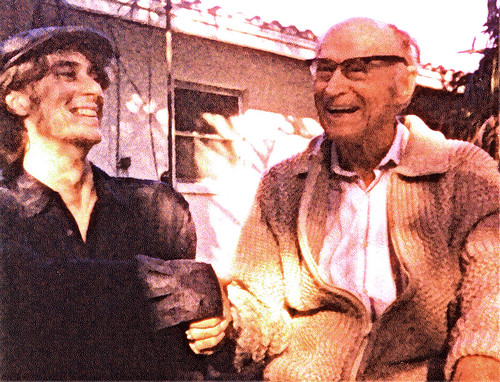
Taken back in the eighties, this photo reflects a more innocent time. the occaision may have been Allens birthday and the image captured late in the afternoon, close to sunset. The original print had a pinkish tone that was most likely a colorful sunset. i removed the odd coloration in my effort to clarify the picture.
Mash took the picture.
Subscribe to:
Posts (Atom)

 Posts
Posts

