Disconnection
Originally uploaded by _william.
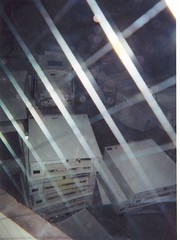
Masha took this shot of old computers stacked up in what used to be the metal shop at Pinnellas Tech.
First they phased out the metals program. Then they junked all the old computers.
Masha took this shot of old computers stacked up in what used to be the metal shop at Pinnellas Tech.
First they phased out the metals program. Then they junked all the old computers.
Newton was fascinated by "the net," the beautiful purple alloy that he made of antimony regulus and copper. Upon close inspection, one can see that the alloy has a surface made up of small crystals separated by interstices. Newton's predecessor and source, "Eirenaeus Philalethes" - the American alchemist George Starkey - first discovered this alloy and named it "the Net," on the basis of its physical appearance. Like Newton, Starkey believed that most of ancient Greco-Roman mythology was really encoded alchemy. The story that Vulcan, the husband of Venus, caught Venus and Mars in bed, in flagrante delictu, became for him (and for Newton), a recipe for "the Net." According to the myth, Vulcan made a fine metallic net and hung the two lovers from the ceiling for all the Olympians to see. Now in alchemy, "Venus" usually means "copper," "Mars" means "iron," and "Vulcan" means "fire." Hence "Venus" referred to the copper in the alloy, and "Vulcan" to the intense heat used in making it. Since the antimony regulus that is added to the copper is itself reduced from stibnite (antimony sulfide) by the addition of iron, "Mars" (iron) was thought to be present in "the Net" as well. Voila - the whole myth becomes a recipe for "the Net."
Egotastic! - The Entertainment Blog: "Egotastic! is an entertainment blog focused on movies, music, television, and celebrities"
It's not that the entertainment bussiness needs support. As much as I feel that I should write an homage to Eddie Guerro, or something about Garth Brooks or Lindsey Lohan, that field is covered. Besides, Egotastic! looks good.

Discuss Blog and Flickr
I started a message board just to try it out.Contribute at will.
If these work out i may post more of them, instead of comments.
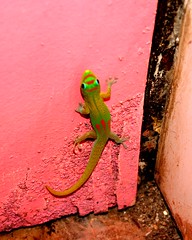
house gecko of Vohemar:
I have to assume that they are the common house lizard in Northeast Madagascar as they were all over the place in Vohemar. That the gecko blended oh-so well with the pink walls of the beach cabin we were staying may even show that it may be one of the everpresent chameleons in the country. I only had one shot so you can actually detect its hurried movement as it scampered away when I took out my camera.
the gold dust day gecko or Phelsuma laticauda
(ID thanks to Ian or reservoir frog)
Vohemar, Northeast Madagascar, East Africa"
Pat: "My email address attracts crud like a Swiffer. Every day, the spam filter sweeps hundreds of messages into a Junk folder. Because I often get genuine messages from people I don?t know, I flick through it once in a while, and whenever I rescue something from a real person, it makes me wonder about the ones I?ve missed. This one I couldn?t miss. The subject line read ?Sorry to inform you that Pat died in her sleep 8-21-05.? It took me three days to open it, and three weeks to sit and write this. When I was twenty, I went to Valencia for a year learn Spanish. That first week I huddled in a hotel above a sex shop, counting my traveller?s cheques for comfort. I had no idea how to find work or friends or a place to live. In the lobby, I met a Californian who had come to Spain to forget a Greek love affair. Debbie showed me the in-cup heating element she used to make tea in her room, and cried because, at 42, she knew now she would never have children. I pitied her, and decided I liked Earl Grey. Debbie was moving on to..."
From Wikipedia
Pancreatic cancer
DiagnosisEarly
Treatment
diagnosis of pancreatic cancer is difficult because the symptoms are so
non-specific and varied. Common symptoms include abdominal pain, loss
of appetite, significant weight loss, jaundice, digestive problems, and
depression.
Pancreatic cancer is usually discovered during the course of the
evaluation of these symptoms by e.g. abdominal CT. Endoscopic
ultrasound (EUS) is another procedure that can help visualize the tumor
and obtain tissue to establish the diagnosis.Treatment of pancreatic cancer depends on the stage
Prognosis
of the cancer [1] Recent advances have made resection of tumors that
were previously unrescetable due to blood vessel involvement possible.
The Whipple procedure is the most common surgical treatment for cancers
involving the head of the pancreas.Patients diagnosed with pancreatic cancer typically
have a poor prognosis because the cancer usually causes no symptoms
early on, leading to metastatic disease at time of diagnosis. Median
survival times from diagnosis of 3-4 months are not unknown.
Pancreatic cancer occasionally may result in diabetes. The insulin
production is hampered and it has been suggested that the cancer can
also prompt the onset of diabetes and vice versa.
Whipple's ProcedureThe Whipple procedure is a technique of
pancreaticoduodenectomy, or surgical removal of pancreatic cancer. It
was named for American surgeon Dr. Allen Whipple who devised the
procedure in 1935 and subsequently came up with multiple refinements to
his technique. (Surgeons in training are often quizzed on the
refinement he made that provided the most improvement in outcomes to
that date: the use of non-absorbable silk over absorbable catgut
suture.)
The first resection for a periampullary cancer was performed by the
German surgeon Kausch in 1909.The Whipple procedure today is very similar to
See
Whipple's original procedure. It consists of removal of the distal half
of the stomach (antrectomy), the gall bladder (cholecystectomy), the
distal portion of the common bile duct (choledochectomy), the head of
the pancreas, duodenum, proximal jejunum, and regional lymph nodes.
Reconstruction consists of attaching the pancreas to the jejunum
(pancreaticojejunostomy) and attaching the common bile duct to the
jejunum (choledochojejunostomy) to allow digestive juices and bile to
flow into the gastrointestinal tract and attaching the stomach to the
jejunum (gastrojejunostomy) to allow food to pass through.
Originally performed in a two-step process, Whipple refined his
technique in 1940 into a one-step operation.
Using modern operating techniques, mortality from a Whipple procedure
is around 5% nationwide (3% in high volume academic centers).
also: Pancreaticoduodenectomy
It's just the thing at the root of everything.
I thought I'd add a couple of notes here
Just some Unfinished Business from the past.
American Red Cross


 Posts
All Comments
Posts
All Comments